Showing posts with label CMMi. Show all posts

30 January, 2012

When Was Your Last Enterprise Architecture Maturity Assessment?

Every company should plan regular architecture capability maturity assessments using a model. These should provide a framework that represents the key components of a productive enterprise architecture process. A model provides an evolutionary way to improve the overall process that starts out in an ad hoc state, transforms into an immature process, and then finally becomes a well defined, disciplined, managed and mature process. The goal is to enhance the overall odds for success of the enterprise architecture by identifying weak areas and providing a defined path towards improvement. As the architecture matures, it should increase the benefits it offers the organisation.

Architecture maturity assessments help to determine how companies can maximise competitive advantage, identify ways of cutting costs, improve quality of services and reduce time to market. These assessments are undertaken as part of the Enterprise Architecture management.

There are some methodologies for assessment of the comprehensive Enterprise Architecture maturity. Examples of these are the US Department of Commerce ACMM, the Open Group architecture maturity model, and a BSC-based Architecture Score Card presented by IFEAD. For application or technology portfolios, portfolio evaluation models can be used.

As a part of project development, assessments (in reality compliance) of architecture solutions are made against the business objectives and requirements (desired process and service structures and business models) and the constraints derived from the Enterprise Architecture context (these may be standards, principles, policies or other restrictions for solution development). Assessment and compliance of technologies are also a central part of Enterprise Architecture development projects. Finally, the development of Enterprise Architectures undergoes the scrutiny of the software development quality assurance method in use. Many IT providers have adopted a comprehensive software quality assurance approach like CMMI, or ISO/IEC 15504 (known as SPICE).

Using the Architecture Capability Maturity Model from TOGAF® 9.1 is a great way of evaluating the way companies have implemented the framework, to identify the gaps between the business vision and the business capabilities. Unfortunately no sufficient assessment instruments or tools have been developed for TOGAF based assessments.

Instruments or tools should contain maturity and documentation assessment questionnaires and a method on how to conduct such an assessment.

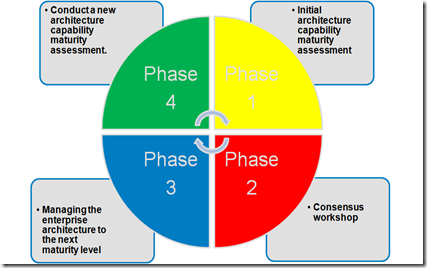
In the following example you may observe four different phases on how to run an assessment.

image

The Phase 1 would include several steps:
  • Planning & preparation workshop with the stakeholders. Stakeholders should represent both Business and IT
  • Interviews with stakeholders based on a questionnaire related to all process areas (elements in TOGAF) or domains that have characteristics important to the development and deployment of Enterprise Architecture. Each process area could be divided into a number of practices, which are statements that describe the process area for each level of maturity, on a scale of 0 to 5. Each practice would have a set of practice indicators, evidence that the requirements for a process area to be at a given level have been met. A set of questions that will be asked in the interviews establishes whether or not the practice indicators exist and thus the level of maturity for the practice. If all the practices for a given level within a Process Area are present, then that level will be achieved. Ideally, directly relevant documentary evidence will be provided to demonstrate that the practice Indicator exists. As this is not always practical, sometimes for this exercise, only verbal evidence from subject matter experts will be considered.
  • Production of a report
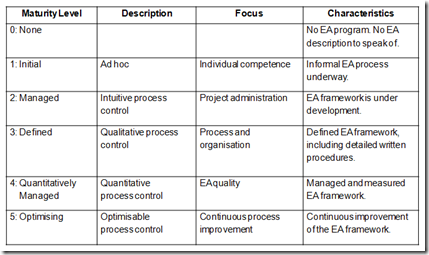
  • Calculation of a maturity score. For the representation, we use the term maturity level or organisational maturity as described below
 
image

Sources

o CMMI for Development (Version 1.2, 2006)
o Appraisal Requirements for CMMI (ARC) (Version 1.2, 2006)
o The US Department of Commerce Enterprise Architecture Capability Maturity Model (2007)
o TOGAF® 9.1
o NASCIO Enterprise Architecture Maturity Model (Version 1.3, 2003)

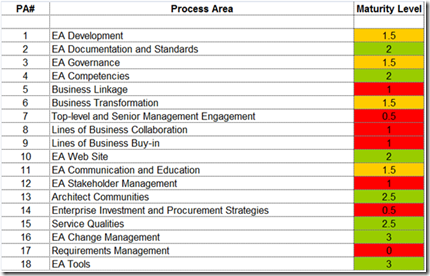
We then deliver a report which includes the maturity of each process area or element. (There are more elements in this example than those in the chapter 51 of the TOGAF® Version 9.1).
image

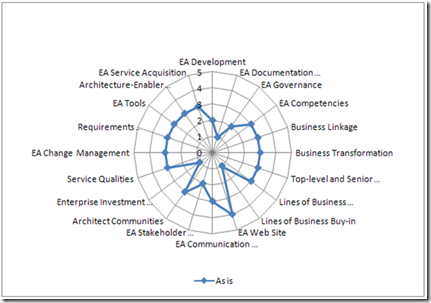
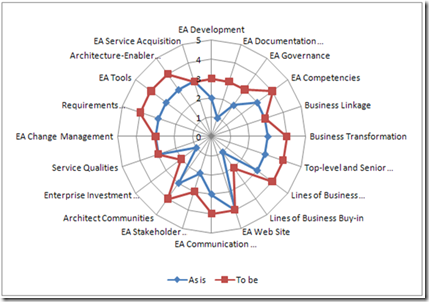
The use of radar may also be a nice way to present the results. (Example below)
image

  • Presentation of the report to the stakeholders with strengths, weaknesses, gap analysis, recommendations
  • Next steps

The Phase 2 would include several steps:
  • Based on results from the Phase 1, a consensus workshop would produce a roadmap and action plan with recommendations to attain the next (required) level of maturity.
  • The workshop would provide a tool to produce an objective view of the report provided in Phase 1. This would give stakeholders and the senior management team a detailed view of how well Enterprise Architecture is deployed in the organisation, it provides a full understanding of the business drivers and organisation issues and a clear view of where the stakeholders want the organisation to be. The outputs of this phase are priorities, and an action plan that is agreed, and understood by the key stakeholders in the organisation. There could also be a target radar diagram as shown below (Example).

image

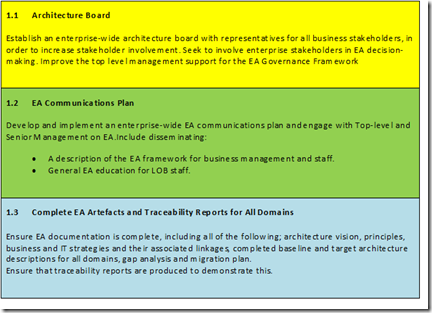
The updated report may then look like this (extract of an example):
image

The Phase 3 would be the management of Enterprise Architecture as described in the report and Phase 4 similar to Phase 1.

To conduct an evaluation of an organization’s current practices against an architecture capability maturity assessment model, allows to determine the level at which the organization currently stands. It will indicate the organisation's maturity in the area of enterprise architecture and highlight the practices on which the organisation needs to focus in order to see the greatest improvement and the highest return on investment. The recommendation is that assessments should be carried out annually.

23 May, 2007

ITIL and CMMI synergies


CMMI has been developed by the Carnegie Mellon University – Software Engineering Institute. It consists of best practices that address the development and maintenance of products and services covering the product life cycle from conception through delivery and maintenance.

A product can be an airplane, a digital camera, a drug or a software package available from a commercial retailer. It can also be a Service such as those defined into IT Service Management. CMMI integrates bodies of knowledge that are essential when developing products, but that have been addressed separately in the past, such as software engineering, systems engineering, and acquisition.

CMMI:
- Emphasizes the development of processes to improve product development and customer services in organizations.
- Provides a framework from which to organize and prioritize process improvement activities (product, business, people, technology)
- Supports the coordination of multi-disciplined activities that may be required to successfully build a product
- Emphasizes the alignment of process improvement efforts objectives with organizational business objectives

A CCMI model is not a process but describes the characteristics of effective processes. CCMI models should be used in conjunction with a company’s IT processes found in Service Management (ITIL), COBIT, Project Management (SDLC/Prince 2), Enterprise Architecture (TOGAF), Quality (ISO 9000), Security Management (ISO 27001). CMMi allows companies to assess their practices and compare them to those of other companies. The CMMi measures process maturity, progresses through five levels: Level 1 (initial), 2 (managed), 3 (defined), 4 (predictable) and 5 (optimizing).

CMMi is an important component of an IT Governance framework and has to be considered as a project.


Implementing CMMI and ITIL improves the Software Development Process and Software Quality and reduces the Cost Of Quality (COQ). In addition is time to market reduced and precision in estimation of effort and cost enhanced.


ITIL can combine with CMMI to cover all of IT, but doesn't address the development of quality management systems. Also it is not geared to software development processes and its use is highly dependent on interpretation. While CMMi is the de facto quality standard for software development processes, ITIL for many is the tool of choice for the operations and infrastructure side of IT, particularly for IT Services.

ITIL and CMMI best apply to different parts of the IT organization:

- Use CMMI in application development
- Use CMMI in ICT Infrastructure projects
- Use ITIL in IT operations and services

CMMi is very detailed. It is geared specifically to software development organizations, and focuses on continuous improvement, not just on maintaining a certification. It also can be used for self-assessment.

However it doesn't address IT operations issues, such as security, change and configuration management, capacity planning, troubleshooting and service desk functions. This is why ITIL is used. CMMi sets goals, but doesn't say how to meet them. (For example, CMMI says to do requirements analysis but doesn't say how to do requirements analysis.) This is why we would use a Project Management methodology.
Important observations

The focus for CMMi is software development, integration, deployment and maintenance, while the focus for ITIL is service management/operations. In reviewing, the touch points between the two , the amount of duplication is small in comparison to the number of interfaces and touch
points. This suggests the need for:

- strongly synchronized work efforts
- clear definition of interfaces, roles, and responsibilities
- participation from both efforts at a level appropriate to the density of the touch points (e.g., joint process action team membership, subject matter expert guidance, and/or process reviewer)
- By identifying the touch points between the groups, and promoting best practices using the CMMI and ITIL in their respective areas, the organization can leverage expertise and experience from within and from without .
- The most significant touch point should be documented in the area of Configuration and Change Management. There is no contradiction between the two models (CMMI and ITIL), so the teams should develop a unified process (‘the what’), with targeted procedures (‘the how’).
- In CMMI, the Process Areas are ordered along a Maturity Model with maturity levels. The ITIL processes are ordered in sets.

28 March, 2007

Achieving IT Operational Excelllence

You may be interested in an article I wrote for a magazine: Pharma Focus Asia Issue 4 2007 titled :

Operational Excellence: IT governance, Enterprise Architecture and service management, which explains what are the components of such a program in my company.

The article will soon be downloadable from http://www.pharmafocusasia.com/magazine/ (issue 4), but I'm copying its content:

IT governance defines a structure of relationships, processes and measures to direct and control IT in order to achieve the enterprise's goals.

IT governance is currently a key topic for many IT functions. Its definition varies very often, but key themes remain essential for all companies: effectiveness, efficiency and reliability. Business value and risk mitigation are also at the centre of this domain. It represents a significant part of enterprise governance, and due to the horizontal nature of IT, wherein almost everyone in the enterpriseuses IT assets to complete their responsibilities, the impact of effective IT governance is most visible.

IT governance defines a structure of relationships, processes and measures to direct and control IT assets (e.g. people, finance, infrastructure) in order to achieve the enterprise's goals by adding value while balancing risk with return. It helps to define roles and responsibilities and specify accountability framework to encourage desirable behaviour in IT and accountability for the use of IT assets. ITgovernance also helps to standardise best practices and define monitoring methods.

For XXXXX International SA, IT governance has always been the responsibility of the IT management team, being an integral part of XXXXX's governance, and consists of the leadership and organisational structures and processes that ensure that the IT function sustains and extends the company’s strategies and objectives to deliver value. IT does this within acceptable risk boundarieswhile taking into account culture, organisational structure and maturity.

For the XXXXX IT function, IT governance ensures that delivery expectations are fulfilled, IT resource deployment is continuously planned, targeted and optimised while IT performance is measurable and that the risks are minimised.Among the various components of an IT governance framework, the following domains were retained as being key themes to reach a high level of quality and excellence through continuous improvement:

• Quality management
• Balance scorecard
• Risk management
• Skills management
• Project and portfolio management
• Service management
• Enterprise Architecture
• Information security management
• Audit management
• IT performance and value management

Quality management was initially the main focus for IT, and since 1999, has been certified worldwide in ISO 9001. For the last two years, quality management has also included risk management(identifying risks from strategy down to operations and providing mitigation) as well as skills management (ensuring that the staff in the IT function have the appropriate skills in line with the strategy).Since 2001, IT measures its business alignment, which is highly integrated within the business strategy, using the IT balance scorecard tool. For more than three years, service management and IT Infrastructure Library (ITIL) have been the drivers to improve the quality of services for the end users. XXXXX's IT function deployed the ITIL processes covering both service support and service delivery. Thepurpose of this initiative was to:

• Increase customer satisfaction with IT
• Enhance communication with clients
• Achieve higher reliability in missioncritical systems and infrastructure
• Improve the cost-benefit of services
• Create a “common sense” among staff

These processes are mostly supported by tools from HP-Peregrine and IBM Tivoli. Project management has always been a key practice for IT people. Based on a traditional System Development Life Cycle (SDLC), the methodology has been widely used by the IT function for manyyears. All projects have to comply with documentation, templates and checkpoints where project progress is monitored.Committees validate the various steps of the methodology and give their approval to move to the next phase.

Portfolio management is known internally as the “Funnel”. The portfolio governance process starts when a business user requests or suggests a new capability. The request is automatically routed to aninformation manager (internal relationship manager), then to a business analyst or team for an initial business case before being routed to the IT management committee for review and scoring. The ITmanagement team then evaluates the prioritised, ranked projects to determine the proper portfolio mix and whether to accept the recent request. The “Funnel” is:

• A categorisation model
• A common language for business and IT to:

> Support business strategy
> Organise investments
> Evaluate and prioritise IT projects
> Govern and manage applications portfolio
> Decide when and how to make changes
> Understand what can and cannot be changed
> Provide real-time visibility into resources, budgets, costs, programmes, projects, and overall IT demand

• An input to the IT strategic planSolutions from HP-Mercury help XXXXX to support both project and portfolio management. An Enterprise Architecture (EA) consists of the vision, principles, standards and processes thatguide the purchase, design and deployment of technology within an enterprise. EA describes the interrelationships between business processes, information, applications and underlying infrastructurefor that enterprise, and provides best practices for technology purchase, design and deployment. EA structures and processes govern adherence to an organisation’s technology strategy and provide amanaged environment for the use of new technology.

Enterprise Architecture

• Allows alignment with the company’s business model and strategy
• Enables business changes, technologically based business opportunities
• Easier introduction of new technologies
• Allows standardisation
• Drives information/data consolidation
• Reduces enterprise-application integration complexity
• Facilitates outsourcing as appropriate
• Utilises assets more efficiently
• Provides the facility to better assess the impact of changes
• Ultimately, reduces time to market

Architecture governance is essentially a control or series of controls in the development process which is efficient when supported by good documentation (principles, guidelines, standards) and communicated effectively. To build such an Enterprise Architecture, XXXXX considered the use of both the Zachman and the Open Group TOGAF’s frameworks. Such a programme requires solid processes with ownership and accountability.

Enterprise Architecture is a component of IT governance which interacts with most of the other frameworks such as project and portfolio management, quality, maturity and security management. To manage EA, the company decided to use the Metis-Troux technologies solution.

Security management is another component of the IT governance programme, covering both information security and technical security. The BS 7799 certification was obtained in 2005 for GenevaHQ and ISO 27001 obtained on a worldwide basis in 2006. At the beginning of 2006, a new position reporting directly to the CIO was created to further develop IT performance and value management. Keydrivers for this are: optimising IT value, demonstrating IT value as a critical component of business processes, improving the quality of IT value measurement and reporting and becoming a potentialsource of innovation.

Performance management is not a stand-alone initiative; it is a process that needs to be established and fully integrated in strategic alignment with the business, value delivery and company performancemanagement. This performance framework consistently ensures that IT:

1. Is adding business value to the corporation
2. Is meeting the real customers’ real needs
3. Is running well as a business

Control Objectives for Information and related Technology (COBIT) provides a set of best practices and tools for auditing IT processes and assessing standards compliance, maturity and associatedrisks. COBIT can be associated to other frameworks, as architecture can be audited with certain KPIs.

In the frame of an IT research and innovation initiative, CMMi has been under evaluation. It is the Capability Maturity Model Integration which has been developed by the Carnegie MellonUniversity – Software Engineering Institute, a suite of products used for process improvement. It consists of best practices that address the development and maintenance of products and services covering the product life cycle from conception through delivery and maintenance.

CCMi models could be used in conjunction with all XXXXXs IT processes found in service management(ITIL), COBIT, project management (SDLC/Prince), Enterprise Architecture (Zachman-TOGAF), quality (ISO 9001), security management (ISO 27001), but the programme has not yet been considered.IT governance at XXXXX encompasses many disciplines within the organisation including IT strategy, risk management, IT service management and compliance management to name a few. Understandably, this presents a significant challenge for companies seeking to identify a starting point for their IT governance initiative. Fortunately, best practice governance guidelines and procedures do exist within the industry. Firms, moving ahead with the adoption of a standard will be well served to utilise a phased implementation project approach and start with elements of the standard that will yield their organisation the most benefits—

• Optimised IT strategy and execution
• Improve resource utilisation
• Improve planning and resourcing
• Risk assessment
• Real-time management reporting

In 2005, a benchmark with KPMG positioned XXXXX’s IT as number one among 119 other companies in the life sciences industry. In 2006, the number one position was maintained while thenumber of organisations increased to 125. This recognition states that the IT functionis using IT best practices to support the business and that XXXXX IT controls can now be classed as “excellent”.This was driven by major improvements in the areas of IT operations (incident, problem, operation, and configuration management), security (ISO27001), control assurance (risk, audit, planning management)and Sarbanes Oxley (SOX).

13 February, 2007

Urbanisation des Systèmes d’Information & Architecture d’Entreprise 2007

Urbanisation des Systèmes d’Information & Architecture d’Entreprise 2007

Communiquer et Vendre son Projet d’Urbanisation comme un Investisssement de long terme & Estimer la Valeur et la Rentabilité de cet Investissement

Event Date: 26-27 March 2007

Location: A Five Star Venue To Be Announced Shortly, Paris, France

14:30 Mise en Oeuvre d'une Gouvernance Informatique, démarche, standards, processus et outils

  • Vision de XXXXXX des composantes d'une Gouvernance IT (ex: ITIL, CMMi, TOGAF, Cobit, ISO)
  • Les standards des domaines de Recherche et Innovation, Architecture d'Enterprise,
  • Service Management ainsi que leurs relations
  • Définition et démarche des processus clés de Gouvernance
  • Choix d'outils pour le support des standards de Gouvernance IT
  • Intégrer l'Architecture d'Enterprise comme composant clé de la Gouvernance
  • Faire fonctionner le tout ensemble!

25 October, 2006

IT Service Capability Maturity Model

CMMI has been developed by the Carnegie Mellon University – Software Engineering Institute. It consists of best practices that address the development and maintenance of products and services covering the product life cycle from conception through delivery and maintenance.

CMMi provides a robust discipline to help developers achieve maturity in their software development processes. There are a number of factors that influence the maturity of the software development processes within an enterprise. These include the strategic plans of the enterprise, the enterprise’s own organization and culture, as well as the technologies that are adopted within the enterprise IT architecture.

A product can be an airplane, a digital camera, a drug or a software package available from a commercial retailer. It can also be a Service such as those defined into IT Service Management. CMMi integrates bodies of knowledge that are essential when developing products, but that have been addressed separately in the past, such as software engineering, systems engineering, and acquisition.

CMMi:
- Emphasizes the development of processes to improve product development and customer services in organizations.
- Provides a framework from which to organize and prioritize process improvement activities (product, business, people, technology)
- Supports the coordination of multi-disciplined activities that may be required to successfully build a product
- Emphasizes the alignment of process improvement efforts objectives with organizational business objectives

A CCMi model is not a process but describes the characteristics of effective processes. CCMI models could be used in conjunction with all IT processes found in Service Management (ITIL), COBIT, Project Management (SDLC/Prince 2), Enterprise Architecture (TOGAF), Quality (ISO 9000), Security Management (ISO 17799). CMMi allows companies to assess their practices and compare them to those of other companies. The CMMi measures process maturity, progresses through five levels: Level 1 (initial), 2 (managed), 3 (defined), 4 (predictable) and 5 (optimizing).

The CMM has been applied to several disciplines within different industries. It is not surprising that maturity models have also been applied to IT Service Management (ITSM).

Recently, the Vrije Universiteit Amsterdam and CIBIT, published a very interesting document “The IT Service CMM” which is free to download and use. This should help companies to evaluate their level of maturity for their ITIL processes, using the CMMi framework.

23 September, 2006

EGEE'06 Capitalising on e-infrastructures

The EGEE’06 conference is the major event of the EGEE project where Grid user communities, decision makers, resource providers and developers will discuss how to capitalise on past investments and plan a sustainable future for the Grid. The EGEE’06 conference will be the focus point of a large number of grid projects featuring prominently in both plenary and parallel sessions during the 5 days of this event. Welcome to the key European grid event of 2006!


QA standards overview and (company) implementation choices and benefits

The first part of the presentation will introduce QA standards such as :

- Service Management (ITIL, ISO/IEC 20000-1/-2:2005)
- CMMi
- Quality Management ISO 9001,
- Security Management ISO 2700

The second part will present (company) implementation choices and benefits

Id: 109
Place: CICG CICG,
17 rue de Varembé,
CH - 1211 Geneva 20
Switzerland
Room: Conf. Room 7+8
Starting date: 27-Sep-2006 11:00
Duration: 45'
Primary Authors: Mr. THORN, Serge (Director IT Research & Innovation)

05 September, 2006

The art (and difficulty) of selecting an IT Governance Framework

IT Governance is one of those concepts that everyone is talking about.

Many companies after having selected a set of IT Governance pillars are looking for solutions to support them and deliver several types of dashboard to either the Corporate and/or IT Management. But, what are these pillars? Some IT department considers one or more components as IT Governance, some other cumulates several components.

IT Managers very often refer to ITIL, or COBIT, or Balance Scorecards or any other frameworks which will improve efficiency and give some visibility to the business.

Let me briefly describe first what I’m considering as components of an IT Governance, but prior to that, I would like to refer to a very simple definition from the Harvard Business School:

“We define IT Governance as specifying the decision rights and accountability framework to encourage desirable behavior in IT”

Fundamentally, IT Governance is concerned about two main things: IT’s delivery of value to the business and mitigation of IT risks.

The components of IT Governance can or should include at least:

- Aligning IT strategy with the business strategy
- Quality Management
- Strategic IT Planning
- Enterprise Architecture
- Project and Portfolio Management (PPM)
- Service Management
- Audit Management
- Security Management
- Risk Management
- Performance Measurement

The list is not exhaustive and could obviously be completed.

I tried to find if there were any IT Governance frameworks available in the market and always ended with specific frameworks related to the components of this IT Governance. ITIL, COBIT, ISO 9000, CMMi and others… Now, from there, where do I start?

What we need is a Framework of Frameworks… where I know where to start, where to pursue, where to end…all of that in an iterative mode..

I recently discovered The Calder-Moir IT Governance Framework http://www.itgovernance.co.uk/page.framework which looks like as a good initiative in terms of standards framing. This has been developed by IT Governance Limited.

Until today, to my knowledge, no single organization has provided a full picture of how to manage IT Governance. Is this framework something which should be seriously be considered or only a way to sell consultancy?